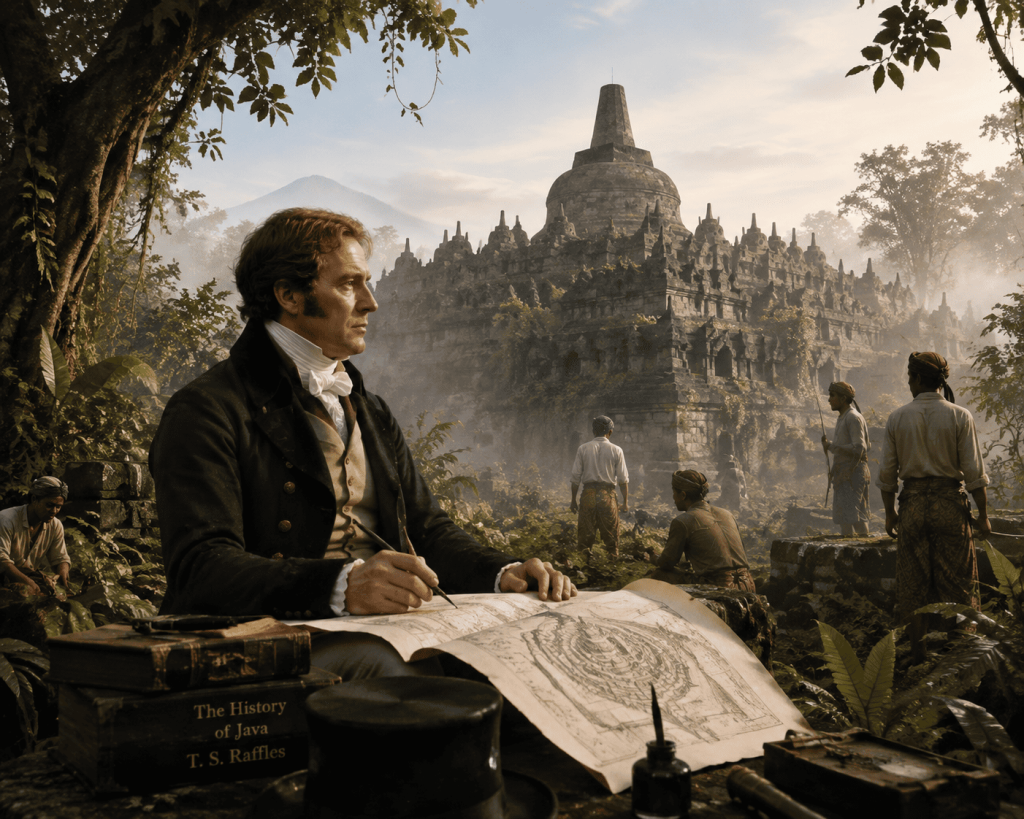

The Thomas Stamford Raffles Borobudur connection represents an important chapter in the modern history of this ancient Buddhist monument. His involvement helped introduce Borobudur to wider attention after centuries of abandonment.
Borobudur had remained hidden under vegetation, soil, and volcanic materials for generations. Raffles played a significant role in encouraging the exploration and documentation of the forgotten temple during the early 19th century.
Thomas Stamford Raffles and Java’s Historical Exploration
Thomas Stamford Raffles served as the Lieutenant Governor of Java during the British administration from 1811 to 1816. During this period, he developed a strong interest in Javanese history, culture, and ancient monuments.
Raffles encouraged the study of historical sites across Java. He collected information about ancient kingdoms, traditional customs, and architectural remains.
His interest in Java’s past led to investigations of several important monuments. Borobudur became one of the most significant discoveries connected to his administration.
Visitors can explore more about this historical journey through Borobudur Temple history, origins, rediscovery, restoration, and legacy.
The Rediscovery of Borobudur in 1814
In 1814, Raffles received reports about a large ancient structure hidden in the forests of Central Java. He ordered an investigation to examine the mysterious monument.
H.C. Cornelius, a Dutch engineer working under British administration, led the first major exploration of Borobudur. His team cleared vegetation and removed layers covering parts of the temple.
The investigation revealed the enormous scale and artistic value of Borobudur. The discovery attracted attention from historians and researchers who wanted to understand the monument’s origins.
Although Raffles did not personally uncover every part of Borobudur, his support helped begin the process of documenting the temple.
Documentation and Historical Research
Raffles included information about Borobudur in his studies of Javanese history. His famous work, The History of Java, published in 1817, discussed various aspects of Javanese culture and ancient heritage.
The documentation encouraged further research into Borobudur’s architecture, Buddhist symbolism, and historical background.
Researchers studied the temple’s reliefs, structures, and inscriptions to understand its connection with the Sailendra Dynasty and Mahayana Buddhism.
The early records created during this period became valuable references for later preservation efforts.
The Impact of Raffles’ Discovery
The involvement of Thomas Stamford Raffles changed the way Borobudur was viewed internationally. Before the rediscovery, the monument remained largely unknown outside local communities.
His administration helped introduce Borobudur to scholars and researchers around the world. The temple later became recognized as one of the greatest achievements of ancient Buddhist architecture.
The rediscovery also highlighted the importance of protecting historical monuments. It encouraged future restoration projects that preserved Borobudur for later generations.
Borobudur’s Legacy Today
Today, Borobudur stands as a UNESCO World Heritage Site and one of Indonesia’s most important cultural attractions. The temple represents ancient Javanese creativity, Buddhist philosophy, and architectural excellence.
Modern visitors continue exploring Borobudur to understand its history and spiritual meaning. The monument remains a symbol of Indonesia’s rich heritage.
Travelers who want to experience this historic site can join a Borobudur Temple tour to discover its architecture, history, and cultural significance.
Conclusion
The Thomas Stamford Raffles Borobudur story shows how historical exploration helped restore attention to a forgotten masterpiece. Raffles’ interest in Java’s heritage contributed to the rediscovery and documentation of Borobudur.
Understanding his role provides deeper appreciation of the temple’s journey from an abandoned monument to a globally recognized cultural treasure.